
Walk into any supplement store or search on Amazon for whey protein, and you’ll instantly be bombarded with dozens of options. The biggest confusion for most beginners is this: Whey Protein Isolate vs Concentrate: Which One Should I Choose?
Both come from the same source (milk), but they differ in processing, nutritional profile, price, and even taste. PROTEIN METER breaks it down in simple terms so you can decide what’s right for your fitness goals.
Table of Contents
What Are Whey Protein Concentrate and Isolate?
Whey protein is a by-product of cheese production. When milk is processed, it separates into casein and whey. Whey is then filtered and dried into protein powder.
- Whey Protein Concentrate (WPC): This is the less processed form of whey, containing about 70–80% protein, with the rest made up of carbs (lactose) and fats. Brands in India like MuscleBlaze 100% Clean Raw Whey Protein Concentrate and asitis ONE Whey Protein Concentrate are popular entry-level options.
- Whey Protein Isolate (WPI): This undergoes additional filtration to remove most of the carbs and fats, resulting in 90% or higher protein content. It’s often marketed as “low-carb” or “lactose-free.” Examples in India include NAKPRO Platinum Whey Protein Isolate and The Whole Truth Raw Whey Protein Isolate.
Key Differences: Whey Protein Isolate vs Concentrate
1. Protein Content
- Concentrate: 22–24g protein per 30g scoop (around 75%)
- Isolate: 26–27g protein per 30g scoop (90%+)
This makes isolate slightly more efficient per scoop if you want maximum protein with minimal extras. Below is a protein per scoop (standardized to a 35g scoop for proper analysis) comparison of the whey protein isolate vs concentrate of major Indian brands. The analysis shows that within the same brand, isolate has more protein content than concentrate.

2. Lactose & Fat Content
- Concentrate contains more lactose (1 – 3g per scoop), which may cause bloating or discomfort if you’re lactose sensitive
- Isolate has very little lactose (often <0.5g), making it safer for those with mild lactose intolerance
3. Taste & Mixability
- Concentrate: Creamier texture, slightly milkier taste. Good for shakes with oats, peanut butter, or smoothies
- Isolate: Lighter consistency, mixes easily with water, but can feel a bit “thin” in taste
4. Price
- Concentrate: More affordable. Popular 1kg packs (e.g., MuscleBlaze 100% Clean Raw Whey Protein Concentrate and asitis ONE Whey Protein Concentrate) cost around ₹2,000 – ₹2,500
- Isolate: More expensive. Generally priced above ₹2,500
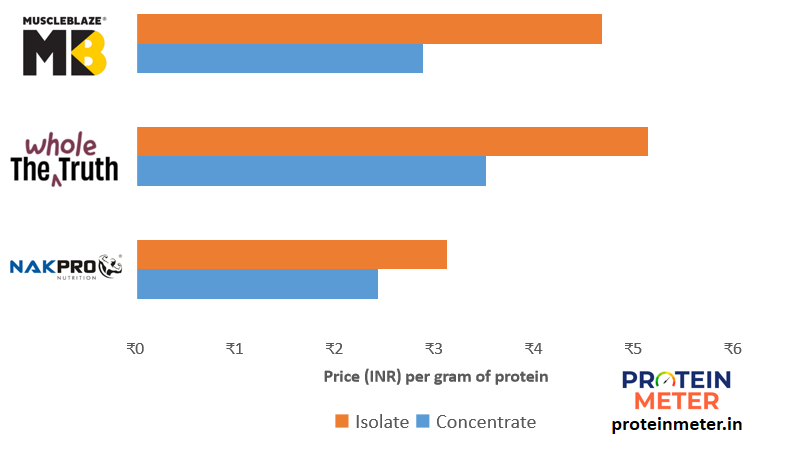
Below is a price comparison of the whey protein isolate vs concentrate of major Indian brands, clearly showing the significantly greater pricing for isolate than concentrate within the same brand. Also, we have written a more detailed whey protein price comparison in India.
Which Is Better for Your Goals?
- For Weight Loss: Go with Isolate. Lower calories, carbs, and fats which will help with maintaining a calorie deficit
- For Muscle Gain/Bulking: Concentrate is more than enough. Affordable, effective, and the extra calories from carbs/fats can help in gaining mass
- For Lactose Intolerance: Isolate is the safer choice, as it has negligible lactose
For most Indian beginners, unless lactose intolerant, a good-quality whey concentrate from a trusted brand will work just fine. You can always switch to isolate later if your goals become more specific.
To understand the broader landscape of whey protein prices in India, have a look at our detailed whey protein price comparison in India.
FAQs
Is whey isolate worth the extra cost?
If you’re cutting, lactose-intolerant, or want maximum protein with fewer calories, yes. Otherwise, concentrate is sufficient for most Indian gym-goers.
Does concentrate cause bloating?
Not for everyone. But if you have lactose intolerance, you may experience bloating, gas, or discomfort.
Can beginners just use concentrate?
Yes. If you’re new to protein powders, concentrate is a cost-effective and perfectly fine starting point.
Leave a Reply